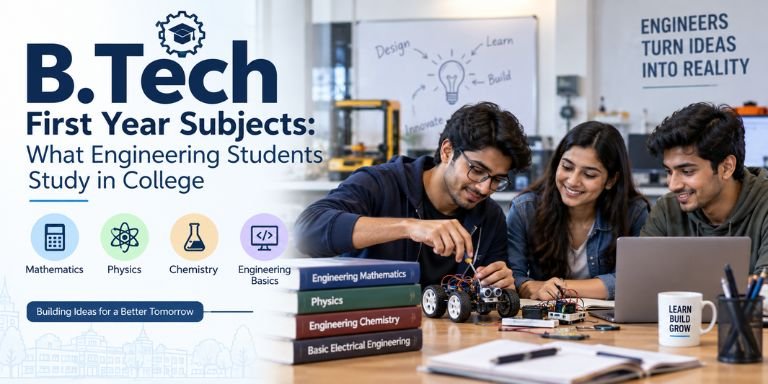
B.Tech First Year Subjects: What Engineering Students Study in College
The first year of engineering is an important transition from school to college. Before starting a Bachelor of Technology degree, students often search for B.Tech first year subjects, B.Tech 1st year syllabus, first semester subjects, practical labs and whether coding is taught from the first year.
Unlike later semesters, where students gradually move toward branch-specific subjects, the B.Tech first year syllabus is usually designed to build fundamental knowledge in mathematics, science, programming and basic engineering.
If you are planning to join engineering college, this guide explains what students generally study during the first year of B.Tech and why these subjects are important for later semesters.
B.Tech First Year Course Overview
B.Tech is generally a four-year undergraduate engineering program.
The first year normally consists of the first two semesters.
| Course Detail | Information |
| Course | Bachelor of Technology |
| Short Form | B.Tech |
| Duration | 4 Years |
| First Year | Semester 1 & 2 |
| Key Subjects | Maths, Physics, Programming, Engineering Basics |
| Learning | Theory + Lab + Workshop |
| Specialization | Becomes More Branch-Focused Later |
The exact B.Tech first year subjects vary depending on university, branch and academic regulations.
Why B.Tech First Year Subjects Are Important
Students from Computer Science, Mechanical, Civil, Electrical and other engineering branches often study several common subjects during the first year.
The reason is simple: every engineer needs strong fundamentals.
The first year engineering subjects help students develop:
- Mathematical ability
- Scientific understanding
- Programming basics
- Engineering thinking
- Drawing and design skills
- Communication skills
- Practical problem-solving
These skills form the base for advanced branch-specific learning.
B.Tech First Semester Subjects
Students searching for B.Tech 1st semester subjects commonly find subjects from mathematics, science and basic engineering.
Typical areas include:
Engineering Mathematics
Engineering Mathematics is one of the most important B.Tech first year subjects.
Students may study:
- Calculus
- Matrices
- Differential equations
- Vector algebra
- Probability
- Numerical concepts
Mathematics later becomes important in almost every engineering branch.
Engineering Physics
Engineering Physics helps students understand scientific principles used in engineering and technology.
Common topics may include:
- Optics
- Waves
- Semiconductor concepts
- Lasers
- Modern physics
- Engineering materials
Engineering Chemistry
Depending on the curriculum, students may study Engineering Chemistry.
Topics may include:
- Chemical bonding
- Electrochemistry
- Polymers
- Corrosion
- Water treatment
- Engineering materials
Programming for Problem Solving
One of the most common student questions is Is coding taught in B.Tech first year?
In many engineering programs, yes.
Students may learn introductory programming using C, Python or another programming language.
Topics can include:
- Variables
- Data types
- Conditions
- Loops
- Functions
- Arrays
- Algorithms
- Problem-solving
Programming is no longer useful only for Computer Science students. It can support problem-solving across multiple engineering fields.
Basic Electrical Engineering
Basic Electrical Engineering introduces foundational electrical concepts.
Topics may include:
- Voltage
- Current
- Resistance
- Electrical circuits
- AC and DC
- Transformers
- Electrical machines
Engineering Graphics
Engineering Graphics or Engineering Drawing teaches students how technical designs and objects are represented.
Students may study:
- Orthographic projection
- Isometric views
- Dimensioning
- Technical drawings
- Engineering sketches
Communication Skills
Engineering professionals need to explain ideas clearly.
Therefore, communication skills for engineering students can include:
- Professional English
- Presentation skills
- Report writing
- Technical communication
- Group discussion
B.Tech Second Semester Subjects
The B.Tech 2nd semester subjects generally continue the basic engineering foundation.
Students may study subjects such as:
- Engineering Mathematics
- Physics or Chemistry
- Programming
- Engineering Mechanics
- Basic Electronics
- Environmental Studies
- Workshop Practice
- Communication Skills
The exact sequence varies by university.
Engineering Mechanics
Engineering Mechanics introduces concepts related to force, motion and equilibrium.
Students may study:
- Forces
- Friction
- Equilibrium
- Centre of gravity
- Motion
- Basic dynamics
This subject is particularly useful for Civil and Mechanical Engineering students.
Basic Electronics
Students may be introduced to:
- Diodes
- Transistors
- Semiconductor devices
- Basic circuits
- Digital electronics concepts
Environmental Studies
Engineering students also need to understand the environmental impact of technology.
Topics can include:
- Pollution
- Natural resources
- Waste management
- Sustainability
- Environmental protection
Engineering Workshop
Engineering Workshop Practice gives students practical exposure to tools, machines and manufacturing processes.
Activities can involve:
- Fitting
- Welding
- Carpentry
- Basic electrical work
- Machine operations
This helps students understand how engineering concepts are applied physically.
B.Tech First Year Subjects Semester Wise
Students commonly search for B.Tech first year subjects semester wise.
A broad example looks like this:
| Semester 1 | Semester 2 |
| Engineering Mathematics | Engineering Mathematics |
| Engineering Physics | Engineering Chemistry/Science |
| Programming | Programming/Computing |
| Basic Electrical Engineering | Basic Electronics |
| Engineering Graphics | Engineering Mechanics |
| Communication Skills | Environmental Studies |
| Laboratory Work | Workshop/Laboratory |
Actual subject combinations should always be checked from the applicable university syllabus.
B.Tech First Year Subjects for CSE
Students searching for B.Tech first year subjects for CSE should know that first-year Computer Science students do not study only coding.
They usually also study common engineering subjects such as:
- Mathematics
- Physics
- Basic electrical/electronics
- Engineering fundamentals
- Programming
Later semesters generally become more focused on:
- Data Structures
- Algorithms
- Database Management
- Operating Systems
- Computer Networks
- Software Engineering
- Artificial Intelligence
B.Tech First Year Subjects for Mechanical Engineering
Mechanical Engineering students usually study first-year fundamentals such as:
- Mathematics
- Physics
- Engineering Graphics
- Engineering Mechanics
- Workshop Practice
- Basic Electrical Engineering
These subjects prepare students for later areas such as manufacturing, machines and thermodynamics.
B.Tech First Year Subjects for Civil Engineering
Civil Engineering students also begin with common engineering fundamentals.
Subjects such as mathematics, mechanics and engineering drawing are particularly important because later studies may include:
- Structural Engineering
- Surveying
- Construction
- Geotechnical Engineering
- Transportation Engineering
B.Tech First Year Subjects for Electrical Engineering
Students may begin with:
- Engineering Mathematics
- Physics
- Basic Electrical Engineering
- Programming
- Electronics
Later semesters focus more strongly on:
- Power systems
- Electrical machines
- Control systems
- Circuits
B.Tech First Year Subjects for Electronics Engineering
Electronics students usually build their first-year foundation in:
- Mathematics
- Physics
- Programming
- Electrical fundamentals
- Basic electronics
Later, they can move toward communication systems, embedded systems and digital electronics.
Is Coding Compulsory in B.Tech First Year?
The query coding in B.Tech first year is increasingly common.
Programming is included in many engineering curricula because coding improves:
- Logical thinking
- Problem-solving
- Computational understanding
- Automation ability
A student does not necessarily need prior coding experience before joining college.
The first year is often designed to introduce basic concepts.
Which Is the Hardest Subject in B.Tech First Year?
Students often search for the hardest subject in B.Tech first year.
There is no single answer.
Depending on the student’s background, challenging subjects may include:
- Engineering Mathematics
- Programming
- Engineering Mechanics
- Engineering Physics
- Engineering Graphics
Students strong in mathematics may find engineering maths easier, while students new to programming may initially struggle with coding.
Practical Labs in B.Tech First Year
Engineering education involves practical learning as well as theory.
Typical B.Tech first year labs may include:
- Physics Lab
- Chemistry Lab
- Programming Lab
- Electrical Lab
- Electronics Lab
- Engineering Workshop
- Graphics Practice
SRGOC’s academic positioning emphasizes strong theoretical foundations along with practical and industry-aligned learning, which fits closely with the purpose of first-year engineering education.
Skills Developed in the First Year of Engineering
The B.Tech first year syllabus helps students begin developing important professional skills.
Problem-Solving
Mathematics and programming improve analytical thinking.
Coding Skills
Programming introduces students to computational problem-solving.
Technical Understanding
Basic science and engineering subjects build technical fundamentals.
Practical Skills
Labs and workshops give hands-on exposure.
Communication
Students learn to present technical information more effectively.
Teamwork
Engineering practicals and projects often involve collaboration.
How to Prepare for B.Tech First Year
Students who want to make their first year easier can prepare in advance.
Revise Mathematics
Focus on:
- Algebra
- Calculus
- Trigonometry
- Coordinate geometry
Learn Basic Coding
Understanding basic C or Python concepts can be useful before college.
Improve Problem-Solving
Do not only memorize formulas.
Engineering requires applying concepts to practical problems.
Take Labs Seriously
Practical sessions are important for understanding how theory works in real engineering situations.
Study Regularly
Engineering subjects become difficult when students leave everything for the examination period.
Difference Between B.Tech First Year and Later Years
The B.Tech first year subjects are generally broader and more foundational.
Later years become more specialized.
| Engineering Branch | Later Subjects May Include |
| CSE | Data Structures, DBMS, Networks, AI |
| Mechanical | Thermodynamics, Manufacturing, Machines |
| Civil | Structures, Surveying, Construction |
| Electrical | Power Systems, Machines, Control |
| Electronics | Communication, Embedded Systems |
This is why a strong first year helps students understand later technical subjects more easily.
Is B.Tech First Year Difficult?
The transition from Class 12 to engineering college can initially feel challenging.
Students may experience:
- Faster academic pace
- New technical subjects
- Practical labs
- Programming
- College-level mathematics
- More independent learning
However, regular practice and strong fundamentals can make the first year manageable.
Why First Year Matters for Engineering Students
Students sometimes treat the first year as only an introductory stage, but it is actually the foundation of the B.Tech degree.
B.Tech first year subjects such as Mathematics, Programming, Physics and Engineering Mechanics support many advanced subjects later.
Students who understand these basics well usually find branch-specific learning easier.
Study Engineering at ShriRam College of Engineering & Management
ShriRam College of Engineering & Management (SRCEM) is the engineering institution under ShriRam Group of Colleges. SRGOC states that SRCEM was established in 1998 and is located at its Banmore campus near Gwalior. The institution emphasizes technical education, practical learning and holistic student development.
Students considering engineering should review current B.Tech branches, eligibility, admission requirements, curriculum and facilities before applying.
FAQs
1. What subjects are taught in B.Tech first year?
Common B.Tech first year subjects include Engineering Mathematics, Physics, Chemistry, Programming, Basic Electrical Engineering, Engineering Graphics and Communication Skills.
2. What are B.Tech 1st semester subjects?
Typical B.Tech 1st semester subjects may include Mathematics, Physics, Programming, Electrical Engineering and Engineering Graphics.
3. Is coding taught in B.Tech first year?
Yes, introductory programming is part of many B.Tech first year syllabi.
4. Are first-year subjects same for all engineering branches?
Many foundation subjects are common, but exact subjects vary according to university and curriculum.
5. What are B.Tech first year subjects for CSE?
B.Tech first year subjects for CSE commonly include Mathematics, Physics, Programming and basic engineering subjects before advanced CSE topics begin.
6. Is B.Tech first year difficult?
It can be challenging initially because students encounter college-level mathematics, programming, labs and new engineering subjects.
7. Which subject is hardest in B.Tech first year?
The answer varies by student. Engineering Mathematics, Programming, Engineering Mechanics and Physics can be challenging for some learners.
8. Are there labs in the first year of B.Tech?
Yes. Students generally have practical sessions related to science, programming, electrical/electronics or workshops depending on the curriculum.
9. How should students prepare for B.Tech first year?
Strengthen mathematics, understand basic coding, practice regularly and focus on concept-based learning.
10. Why are B.Tech first year subjects important?
They build the mathematical, scientific and engineering foundation needed for advanced branch-specific subjects.